Risk Management for Active Traders: Position Size Before Profit Targets
Risk management begins before the profit target. Learn how invalidation, account risk, and position size work together in a repeatable trading process.
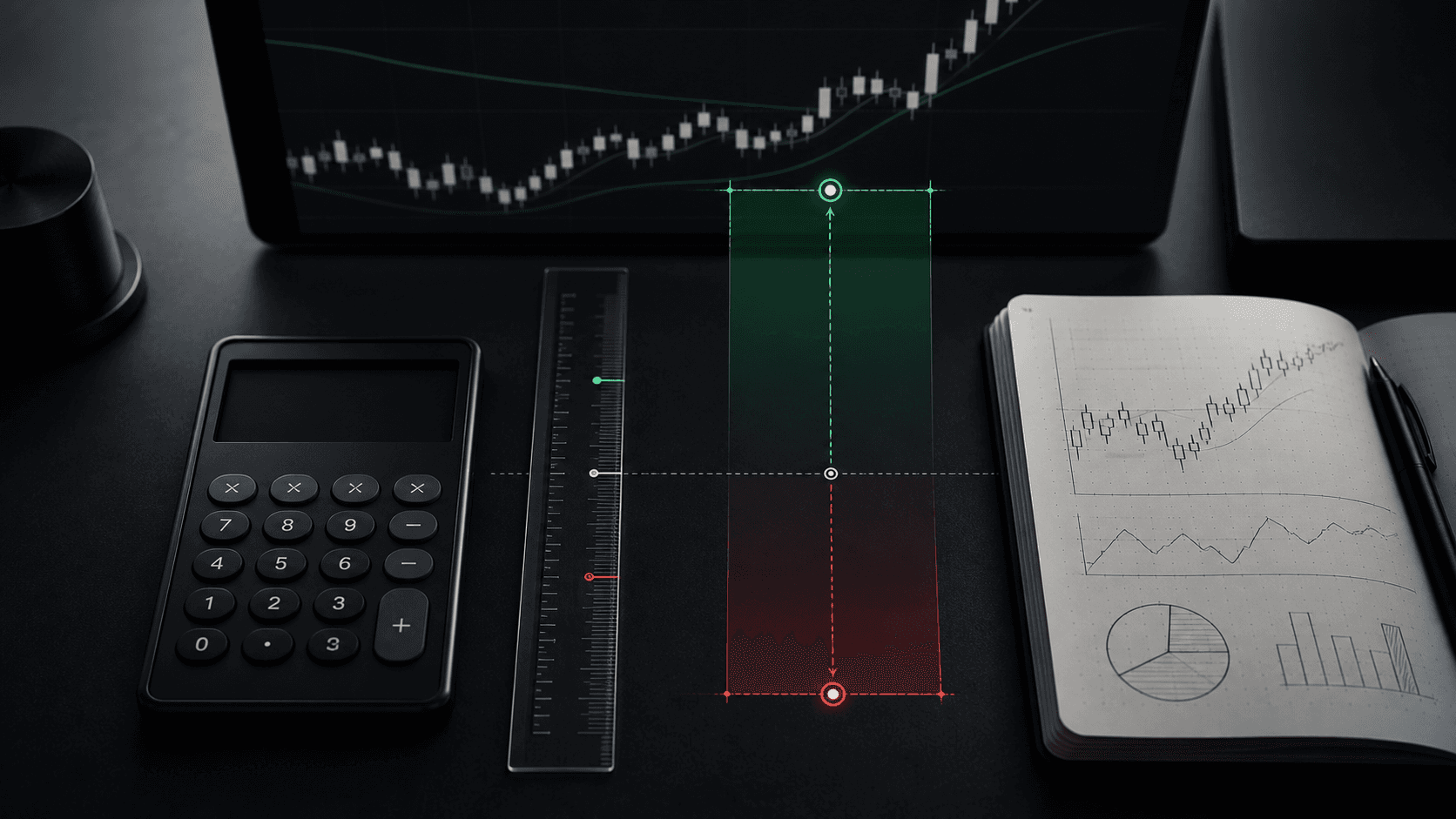
Many traders begin with the upside: How far could this move? A risk-first process begins with a different question: Where is the idea invalid, and how much am I willing to lose if that happens?
Once those two inputs are clear, position size becomes a calculation instead of an emotional decision. That sequence helps keep a normal losing trade from becoming an outsized account event.
Start with risk per trade
Risk per trade is the maximum planned loss if the stop is executed as intended. Many traders express it as a small percentage of account equity or as a fixed dollar amount. The appropriate limit depends on your strategy, experience, drawdown tolerance, and financial circumstances.
Whatever method you use, define the limit before the session. Increasing it because a setup feels especially convincing defeats the purpose of a consistent risk framework.
Place the stop where the idea is wrong
A technical stop should correspond to invalidation. That may be beyond a structural level, a volatility boundary, or another condition supported by your tested setup.
Stops that are too tight can be triggered by ordinary movement. Stops that are too wide can create unnecessary loss. The answer is not a universal distance—it is a repeatable rule that fits the instrument and strategy.
Calculate position size from the stop distance
The core calculation is straightforward: divide the amount you are willing to risk by the risk per share, contract, or unit. If the planned risk is $100 and the difference between entry and stop is $2 per share, the theoretical size is 50 shares before fees, slippage, and instrument-specific constraints.
This is an educational example, not a recommendation. Real execution can differ from a planned stop, especially in fast or illiquid markets.
- Planned risk: the maximum loss budget for the trade
- Unit risk: entry price minus invalidation price, adjusted for the instrument
- Position size: planned risk divided by unit risk
Evaluate reward relative to risk
A reward-to-risk estimate compares the distance to a reasonable target with the distance to invalidation. It is useful only when both levels come from market structure and your strategy—not when the target is stretched to make the ratio look attractive.
A high ratio does not guarantee a good trade, and a lower ratio may still be viable for a strategy with a higher win rate. Evaluate the ratio alongside your setup's historical data.
Set portfolio and daily guardrails
Trade-level risk is only one layer. Correlated positions can behave like one concentrated bet, and several acceptable losses can compound into a poor session. Consider limits for total open risk, correlated exposure, daily loss, and consecutive losses.
- Cap total risk across all open positions
- Reduce duplicated exposure to the same market theme
- Define a daily stop and a rule for stepping away
- Lower size when volatility or execution quality changes materially
Review execution, not just P&L
A losing trade can be well executed, and a profitable trade can violate every rule. Track whether you respected the planned entry, size, stop, and exit. Over time, that process data can reveal whether the issue lies in the strategy, its execution, or the risk parameters.
The objective is not to eliminate losses. It is to make losses planned, survivable, and informative while preserving the ability to take the next qualified setup.
This article is for educational and informational purposes only. It is not financial or investment advice. Trading involves substantial risk, and past performance does not guarantee future results.